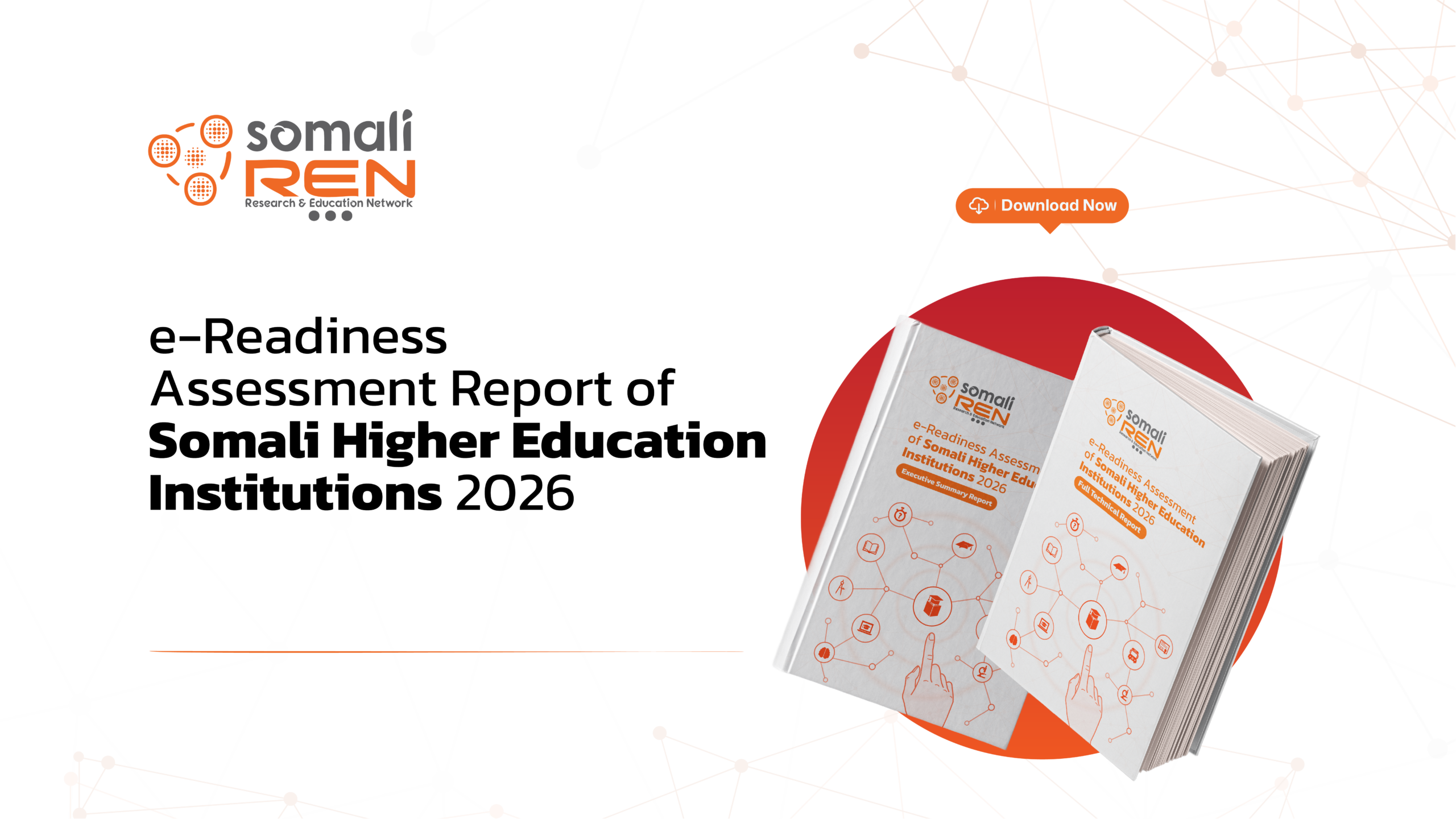
The Somali Research and Education Network (SomaliREN), in collaboration with the Ministry of Communications and Technology has published the Somali Higher Education e-Readiness Assessment Report 2026, providing the first sector-wide institutional baseline of the conditions that enable or constrain reliable and sustainable digital service delivery across Somali higher education. The assessment translates evidence into a staged, decision-oriented pathway to inform policy, investment and partnership decisions. It does not rank institutions, nor does it measure individual digital skills or student access.
The assessment covered 52 higher education and research institutions and analyzed readiness across six domains: infrastructure and systems, human resources and capacity, governance and planning, core digital systems, financial sustainability, and security and risk management. Findings are synthesized through a four-tier readiness framework designed as a practical tool for sequencing support and guiding action.
Readiness remains uneven across the sector. 34% of institutions fall in Tier 1 (Foundational), 62% in Tier 2 (Emerging), and 4% in Tier 3 (Developing), with none in Tier 4, which remains an aspirational benchmark aligned with good practice.
A major finding relates to internet bandwidth adequacy. The median institution serves 2,069 users with 77.5 Mbps, equivalent to 0.04 Mbps per user, far below levels needed to support modern digital learning and research. A scale penalty is evident, with connectivity capacity declining as institutions grow.
The assessment identifies six structural constraints shaping readiness: connectivity adequacy, financial sustainability, operational capacity, fragmented core systems, security and continuity gaps, and governance weaknesses. Persistent bottlenecks, including high connectivity costs, duplication, inconsistent security practices, and dependence on short-term funding, point to the need for a coordinated system response rather than fragmented campus-by-campus interventions.
The report positions SomaliREN as a delivery platform for pooled procurement, shared services, common standards, and coordinated delivery to improve value for money, raise baseline quality, and reduce fragmentation. It also highlights EARDIP as a catalytic opportunity to finance shared foundations and delivery capacity rather than fragmented upgrades.
Recommendations are sequenced across 0–6, 6–12 and 12–18 months, supported by six-monthly governance reviews and an annual tier-based progress review, providing a practical roadmap for implementation.
This assessment marks an important milestone for evidence-based digital transformation in Somali higher education, offering a practical foundation for coordinated action to strengthen digital infrastructure, improve service reliability, and advance a more resilient and connected higher education ecosystem.
Download the Executive Summary and Full Technical Report:
https://doi.org/10.20374/sorer/546
Lorem ipsum dolor sit amet.
Lorem ipsum dolor sit amet.
Lorem ipsum dolor sit amet.
Explore features that help your business, no matter your size.
Lorem ipsum dolor sit amet.
Lorem ipsum dolor sit amet.
Lorem ipsum dolor sit amet.
Explore features that help your business, no matter your size.